
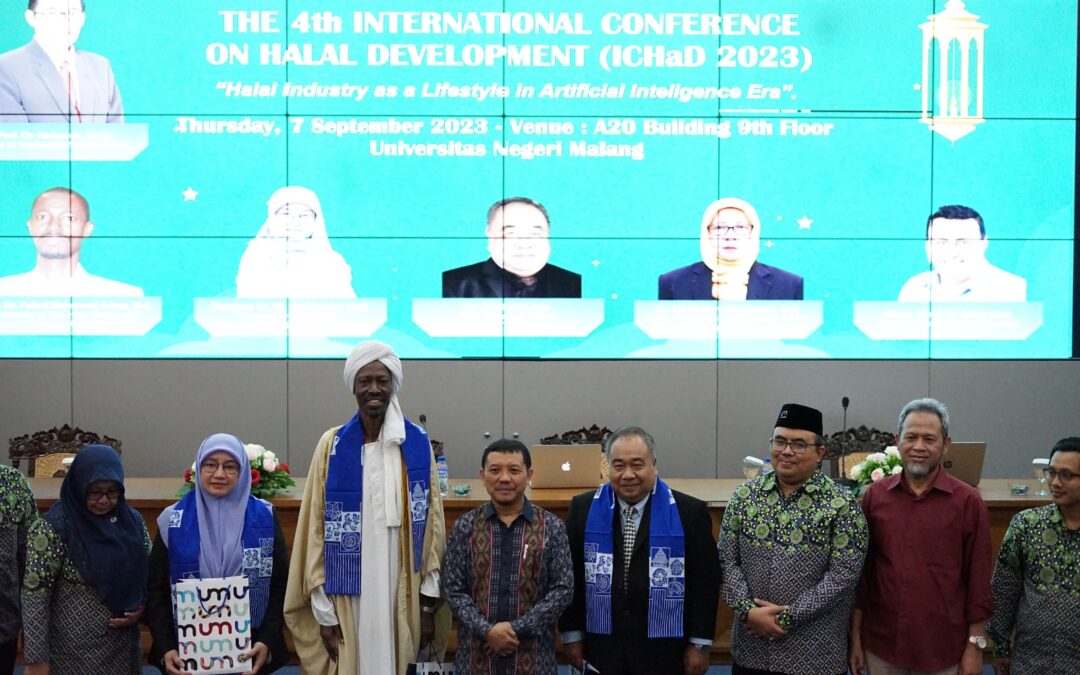
The Center of Health and Food, Universitas Negeri Malang held the fourth International Conference on Halal Development (ICHaD) on Thursday, September 7th, 2023 in a hybrid (offline and online) manner. The seminar entitled Halal Industry as a Lifestyle in Artificial Intelligence Era was attended by various speakers from various countries such as Prof. Dr. Faisol Mahmoed Adam (Sudan), Assoc. Prof. Adam Voak (Australia), Dr. Azmi Abd Aziz (Malaysia), Pg. Dr. Hjh. Norkhairiah binti Pg. Haji Hasim (Brunei Darussalam), and Dr. Titi Mutiara Kiranawati (Indonesia). Dr. Abdul Basid, Ph.D as the chief executive of the activity said in his speech that this year there were 46 presenters and 259 participants from Indonesia and abroad (such as Malaysia, Brunei Darussalam and India) who had registered in this activity. “The participants are expected to exchange ideas in developing the halal industry globally to support the implementation of a halal lifestyle in an era with rapid technological development,” said Abdul Basid.
Furthermore, Prof. Dr. Ahmad Munjin Nasih as Vice Rector III in his opening added, “the theme of Halal Lifestyle in the Era of Artificial Intelligence was chosen at this year’s seminar to contribute to the importance of Halal for improving the quality of people’s lives, social equality, and simultaneously realizing an adaptive attitude towards changing times that need to be studied further regarding their halalness”. According to him, this theme is able to encourage public awareness to open their minds and apply the principle of halalness in various aspects, especially technological developments.
Dr. Titi Mutiara Kiranawati as the head of the Center of Health and Food LPPM UM gave a positive response to the seminar activity. “This activity is an annual event from the UM Health and Food Center as a form of contribution to the development of Halal not only from a religious perspective, but also from a scientific and social perspective. This year ICHaD 2023 received a wide range of presentation topics including: Halal Lifestyle and Regulation; Sharia Economics and Finance; Religion, Culture, and Theology; Health, Food and Nutrition; and also Halal Tourism, “she concluded. In addition, she also explained that the implementation of this activity also supports the achievement of the Sustainable Development Goals, especially point 12 regarding responsible production and consumption and point 17 related to cooperation for the achievement of sustainable development.