
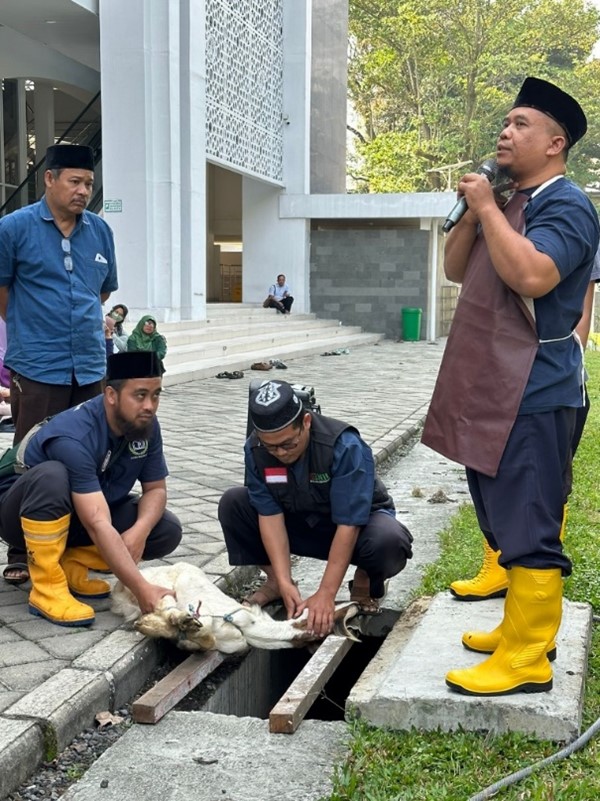
Center of Health and Food LPPM UM succesfully held a Halal Butcher (JULEHA/Juru Sembelih Halal) socialization at Saturday, June 24, 2023 at the Al-Hikmah mosque, State University of Malang. This activity is a routine activity held before Eid al-Adha, with the theme carried out this year being “Socialization of Critical Points of Slaughter and Pre-Training of Halal Butchers (JULEHA) 2023: Getting to Know the Critical Points of Slaughtering Qurban Animals”. This activity presented three speakers, namely: M. Wahyudin, S.E. (JULEHA), Dr. Drs. KH. Moh Khasairi, M.PD (MUI), and drh. Anton Pramujiono (Food Security Agency).
“This year’s JULEHA socialization is different from last year’s event where out of the 50 participants who came from the mosque administrators around Malang Raya and Baitul Maal Hidayatullah (BMH) Malang, 25% were women. This shows that the importance of halal animal slaughter needs to be known to women as a form of emancipation, “said Dr. Titi Mutiara Kiranawati in her speech given as the Head of the Center for Health and Food. In line with this, in the opening of the event delivered by the Vice Rector III, Dr. Ahmad Munjin explained that the socialization of JULEHA plays an important role in the provision of halal food products because halal food ingredients if not processed in Islamic law will produce haram food products.
The first material presented by M. Wahyudin, S.E. as a representative of JULEHA described matters related to the competence of slaughterers, specifications of slaughter tools according to SKKNI, the process of slaughtering sacrificial animals, and factors that affect the slaughter process. “If observed in the community, many sacrificial animals are covered with covers such as banana leaves or sacks so that the observation of blood emission is difficult to observe. Therefore, the slaughterer does not need to cover the head of the sacrificial animal during slaughtering,” he said. This is related to the important things in the slaughtering process, namely the incision is done once (the knife is not lifted), there is a smooth blood flow, and the death of the sacrificial animal is due to the slaughtering process.
Dr. Drs. KH. Moh Khasairi, M.Pd as the second speaker gave a presentation on Qurban Animal Fiqh. This includes how to slaughter in accordance and not in accordance with Islamic law, Sunnah of slaughtering sacrificial animals, halal sacrificial animals that are not allowed to be slaughtered, and the potential for sacrificial animals to become carrion due to improper processes. In the last session, drh. Anton Pramujiono explained that one of the objectives of slaughtering sacrificial animals is to obtain a food source (meat) that is ASUH (Aman Sehat Utuh Halal). Safe is the absence of disease contamination in the meat, Healthy is the presence of nutritional elements, Whole is pure and not mixed with other parts, and Halal is in accordance with Islamic law. In addition, several types of diseases and their effects on sacrificial animals that are rampant in 2023 were also presented, such as Lumpy Skin Disease (LSD) and Peste des Pestitis Ruminants (PPR).